Plastic pails are widely used in industries such as food, chemicals, and pharmaceuticals for safe storage and transportation of liquids, powders, and granular materials. Ensuring their strength and durability is essential for product protection and supply chain efficiency. A compression strength test evaluates how well plastic pails can withstand external loads during stacking, shipping, and storage, helping manufacturers and quality control personnel maintain high standards.
Testing plastic pails is not only about preventing deformation or failure; it also provides critical data to optimize design, meet regulatory requirements, and improve production quality. The box compression test standard, such as ASTM D642, serves as the guideline for assessing compressive resistance and establishing consistent quality benchmarks.
ASTM D642 and Compression Strength Testing
ASTM D642 specifies the procedure for conducting compression tests on shipping containers, including plastic pails, boxes, and drums. This method measures the ability of containers to resist compressive forces applied to their faces, edges, or corners, either with or without contents.
Importance of Compression Testing
- Ensures container integrity during stacking and transport.
- Simulates real-world loading conditions, including vertical stacking and lateral impacts.
- Provides quantitative data to compare different container designs or materials.
By following ASTM D642, manufacturers can identify weak points in plastic pails, verify compliance with packaging standards, and reduce the risk of product damage in transit.
Compression Strength Test Procedure
A typical compression strength test involves the controlled application of force using a testing machine until the plastic pail or container deforms or fails.
1. Sample Preparation
- Select representative pails from production batches.
- Fill with typical contents or simulate load conditions if required.
- Inspect for surface defects or anomalies that could influence test results.
2. Test Orientation
- Top-to-Bottom Orientation: Measures vertical stacking strength, commonly used for unit loads.
- Edge-to-Edge Orientation: Evaluates lateral compressive resistance.
- Corner-to-Corner Orientation: Determines the weakest points of the container, important for handling and transport safety.
3. Testing Process
- Place the pail on the testing machine platen.
- Apply a compressive load gradually, either with a fixed or swiveled platen.
- Record the maximum load sustained before deformation or failure occurs.
4. Data Analysis
- Document the compression strength and failure mode.
- Test multiple pails to ensure statistical reliability.
- Compare results against quality thresholds and design specifications.
Applications of Compression Strength Testing
The compression strength test has a wide range of applications in the packaging industry:
- Quality Control: Confirms that plastic pails meet minimum load-bearing requirements.
- Design Optimization: Data helps engineers improve wall thickness, ribbing, or material selection for better performance.
- Regulatory Compliance: Ensures adherence to ASTM D642 and other packaging standards.
- Transport Safety: Reduces risk of deformation, leakage, or product loss during storage and shipping.
While compression testing evaluates strength under static loads, it should be combined with impact, drop, and stacking tests for a comprehensive evaluation of packaging performance.
Cell Instruments PCT-01 Package Compression Tester
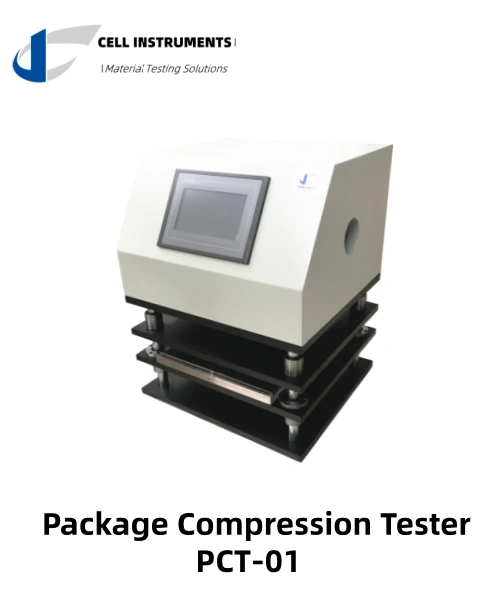
The Cell Instruments PCT-01 Package Compression Tester is ideal for evaluating plastic pails according to ASTM D642 and other box compression standards.
- ASTM D642 Compliant: Ensures reproducible and accurate testing results.
- Adjustable Platens: Supports top-to-bottom, edge-to-edge, and corner-to-corner orientations.
- Precision Sensors: Measure load and deformation accurately, providing reliable data for QC documentation.
- User-Friendly Interface: Simplifies setup, operation, and data recording.
- Efficient Testing: Speeds up batch testing for production quality control.
By using the PCT-01, manufacturers can guarantee that their plastic pails consistently meet design and safety requirements, ensuring durable packaging and protecting product integrity.
Conclusion
Ensuring the durability of plastic pails is crucial for safe storage, transportation, and long-term product protection. The compression strength test, guided by ASTM D642, provides a reliable method to assess the load-bearing capacity and resilience of these containers.
When combined with proper quality control practices and instruments like the Cell Instruments PCT-01 Package Compression Tester, manufacturers can optimize container design, improve production quality, and deliver safe, reliable packaging solutions to customers.
Regular compression testing not only ensures compliance with the box compression test standard but also enhances consumer confidence and operational efficiency across the supply chain.
 EN
EN  AR
AR  BG
BG  CS
CS  DA
DA  DE
DE  EL
EL  ES
ES  ET
ET  FI
FI  FR
FR  HU
HU  ID
ID  IT
IT  JA
JA  KO
KO  LT
LT  LV
LV  NB
NB  NL
NL  PL
PL  PT
PT  RO
RO  RU
RU  SK
SK  SL
SL  SV
SV  TR
TR  UK
UK